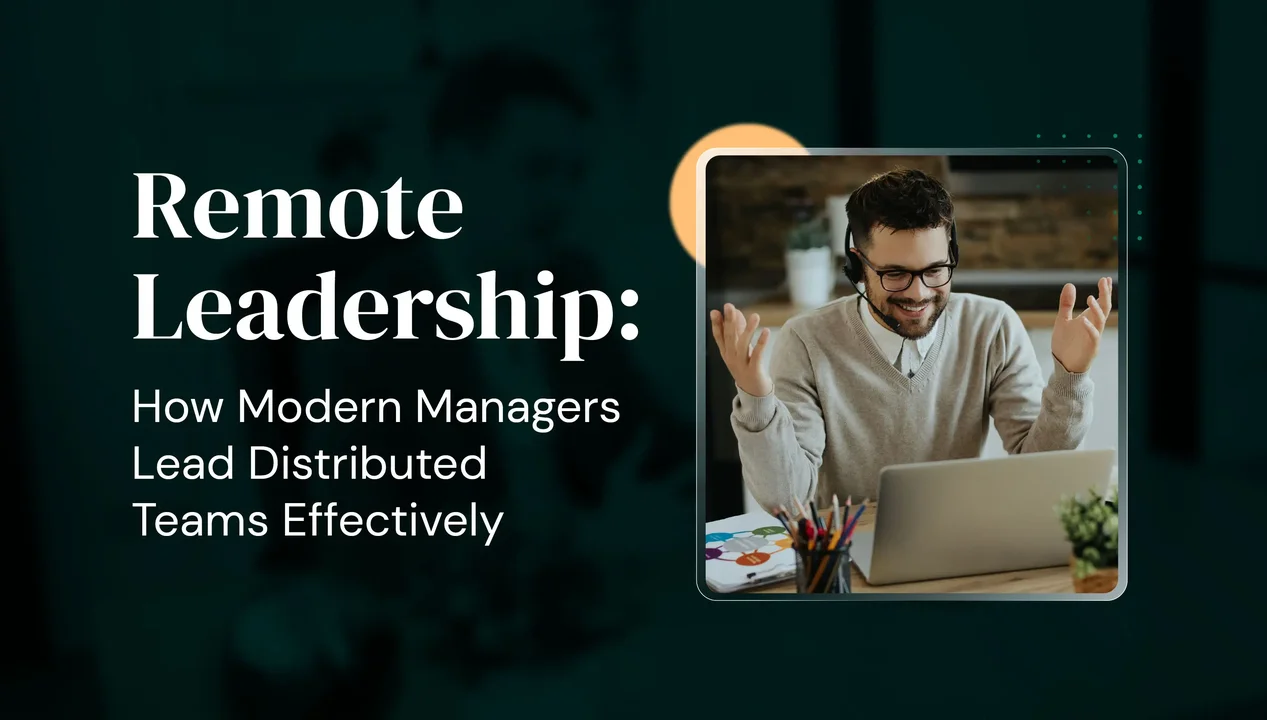
In my network, there’s a product manager who nearly burned herself out trying to keep a distributed team aligned across three time zones. She wasn’t inexperienced, far from it, but she tried to run a fully remote team with the same mix of quick standups, hallway clarifications, and ad hoc syncs she relied on in the office. The result was a blur of late-night pings, duplicated work, and a calendar so crowded she joked she “lived inside a time-zone converter.”
The issue wasn’t effort. It was the absence of a remote-native operating system. The turning point came when she shifted the team to async-first rituals, clarified decision ownership, and moved communication into predictable channels. Within weeks, throughput stabilized, meetings shrank, and she finally got her evenings back.
That experience captured an essential truth: remote leadership is about designing systems where clarity, accountability, and connection don’t depend on proximity.
Why Remote Leadership Requires a Different Management Model
When teams spread across time zones, the management habits that work in an office (quick clarifications, informal coaching, ambient awareness) stop being available. Remote work removes the shared context leaders often rely on, exposing gaps in how information flows and how alignment is built.
Distributed teams need an explicit operating system. Communication has to become intentional, with clear channels and clear distinctions between what requires real-time discussion and what doesn’t. Leaders can’t depend on intuition to understand progress. They need systems that surface updates, blockers, and decisions without constant check-ins.
Autonomy becomes a multiplier only when outcomes are defined precisely. Trust shifts from proximity (“I see you working”) to output (“the work is moving because our process shows it”). That shift demands a move away from managing time and toward managing clarity and results, often creating more stability than traditional office-based models.
Building the Foundations: How High-Performing Distributed Teams Stay Aligned
The highest-performing distributed teams aren’t faster because they work more hours. They’re faster because the system they operate within removes ambiguity. Remote work magnifies every gap in expectations, communication, and decision-making, which is why leaders need to build alignment into the infrastructure of how the team works instead of relying on individuals to compensate for structural inefficiencies.
Establish Role Clarity That Eliminates Guesswork
In a remote environment, ambiguity becomes expensive. People can’t swivel their chairs to confirm ownership or ask someone to “take a quick look,” so leaders need to define roles at a more atomic level than they would in an office.
Effective role clarity frameworks outline:
- What each person owns (not just tasks, but domains and decisions)
- Which decisions they can make independently
- Where responsibilities intentionally overlap
- How handoffs occur
This isn’t bureaucracy-it’s friction removal.
Design Communication Layers with Intent
Distributed teams need different channels for different types of information. Without this structure, everything becomes a meeting, or worse, a series of fragmented DMs that never accumulate into shared knowledge.
A strong communication model includes:
- Asynchronous channels for routine updates, project tracking, documentation, and decisions
- Synchronous communication is reserved for topics that require dialogue, alignment, or real-time feedback
- Escalation paths that clarify how to unblock work without derailing the team
When the team knows where information lives, speed becomes a byproduct of predictability.
Shift from Activity Tracking to Outcome-Based Goals
Remote teams thrive when success is defined in measurable outputs rather than visible effort. Leaders should anchor goals in:
- Clear deliverables
- Defined success metrics
- Shared understanding of constraints and timelines
Outcomes provide a north star that eliminates the need for constant supervision.
Treat Documentation as Infrastructure, Not Admin Work
Remote teams break when institutional knowledge lives in people’s heads, or worse, in chat threads that disappear by the next sprint. Documentation must function as the team’s source of truth, and leaders are responsible for modeling and reinforcing its use.
Strong documentation helps teams:
- Ramp up new members faster
- Reduce repeated questions
- Make decisions visible and referenceable
- Maintain continuity across time zones
.webp)
How Successful Remote Managers Communicate with Intent
When teams span time zones, communication stops being a background function and becomes a core leadership discipline. You can’t rely on serendipitous conversations or quick clarifications, so the way you communicate has to do more than transmit information. It has to create cohesion, surface decisions, and keep work moving without unnecessary interruptions.
Design Communication Around Time Zones
The best remote managers build rhythms that respect the geography of their team rather than fight it. That usually means adopting an async-first approach and treating synchronous time as a scarce, high-value resource.
A strong time-zone-aware model typically includes:
- Overlapping hours reserved for collaboration that truly requires dialogue
- Meeting minimalism, where every meeting has a purpose, agenda, and intended outcome
- Async workflows for status updates, briefs, decisions, and documentation
When people don’t have to wait for someone else’s workday to begin, velocity increases naturally.
Treat Writing as a Core Leadership Skill
In distributed teams, writing becomes the interface through which work happens. Leaders who write clearly (briefs, decisions, feedback, next steps) compound their team’s speed because they eliminate the ambiguity that stalls progress.
Effective written communication includes:
- Concise context (what’s happening and why it matters)
- Explicit decisions (who decided what, and when)
- Clear next steps with owners and deadlines
- Assumptions stated, not implied
Well-written documentation prevents misalignment and reduces the need for meetings.
Establish Team Norms That Reduce Cognitive Load
Remote teams thrive when expectations aren’t just implied but codified. Leaders should create norms for:
- Response expectations (e.g., “Under four hours on critical threads; next business day for non-urgent items”)
- Decision-making protocols (who drives, who gives input, who approves)
- Knowledge sharing (where information goes, what gets documented, when summaries are required)
Consistency builds trust and reduces unnecessary back-and-forth.
When Synchronous Communication Is Necessary
Some conversations can’t be done well in text, particularly those requiring emotional nuance, tight collaboration, or high-stakes alignment. But remote leaders don’t default to meetings. They deploy them strategically.
A high-quality remote meeting:
- Starts with a written agenda circulated beforehand
- Assigns clear roles (owner, facilitator, note-taker)
- Documents decisions and action items in real time
- Concludes with a summary that goes into the team’s source of truth
The goal isn’t to eliminate meetings. It’s to make sure they’re the right tool for the job and that they earn their place on the calendar.
Driving Accountability Without Micromanagement
Remote leadership elevates accountability from a managerial tactic to an operational pillar. Without shared office space, you can’t rely on visual cues or hallway check-ins to gauge progress. But the answer is building a system where commitments are visible, outcomes are measurable, and autonomy becomes a source of speed rather than risk.
Replace Check-Ins with Clear Commitments
Accountability in remote teams is strongest when expectations are explicit and time-bound. Leaders should move away from “How’s it going?” and toward “What will be delivered, by whom, and by when?”
Strong commitments share three traits:
- Defined outcomes rather than activity descriptions
- Aligned timelines that account for dependencies and time zones
- Documented ownership so progress is visible to the entire team
When commitments are clear, leaders don’t need to hover. Progress reveals itself through the work.
Establish Weekly Operating Rituals
Remote teams thrive when the week has a predictable rhythm. These rituals act as checkpoints without becoming surveillance.
Common operating patterns include:
- Monday goals: Each person publicly states planned outcomes for the week
- Midweek blockers: A lightweight async thread to surface issues early
- Friday summaries: A short recap of what shipped, what slipped, and what needs support
These rituals help teams self-correct quickly and reduce the managerial overhead that often leads to micromanagement.
Use Transparent Dashboards
Visibility shouldn’t feel like policing. When dashboards are shared with the entire team, they shift accountability from “manager watching employee” to “team aligned around outcomes.”
Effective dashboards track:
- Project status and milestones
- Ownership and dependencies
- Workload distribution
- Delivery metrics relevant to the team’s domain
Transparency creates peer accountability. One of the strongest motivators in distributed environments.
Model Accountability from the Top
Remote leadership is participatory. When managers share their own priorities and progress, they normalize openness and reduce the perceived risk of visibility.
A leader’s weekly update should include:
- What they’re driving
- Decisions made
- Where they need input
- What’s coming next
This kind of transparency demonstrates that accountability is cultural rather than hierarchical.
Use Async Tools to “Show the Work” Without Meetings
In remote settings, meetings often get scheduled simply because leaders don’t know how else to check progress. Async tools solve this problem by making work visible without requiring synchronous time.
Examples include:
- Short Loom updates for project walkthroughs
- Comments and checklists in project management systems
- Threaded decision logs
- Lightweight demos or GIF-based updates
Building Trust, Cohesion, and Culture Across Distance
In distributed teams, culture is built through consistency. Remote leaders create cohesion by reducing uncertainty, not by manufacturing social moments or trying to compensate for the office.
Make Psychological Safety Structural
Psychological safety grows fastest when expectations, decisions, and communication norms are predictable. When people know how work moves, they take risks more confidently. Consistency beats virtual happy hours every time.
Use Rituals That Strengthen Connection
Lightweight, purposeful rituals help teams stay anchored:
- Rotating demos to showcase progress
- Open office hours for real-time guidance
- Cross-functional retros to sharpen collaboration
These rituals build shared identity without forcing artificial bonding.
.webp)
Address Conflict Early and with Structure
Remote conflict doesn’t flare up suddenly. It shows up as misalignment, silence, or slow-moving work. Leaders should intervene with a simple structure: clarify the issue, restate goals, outline options, and document agreements.
Lead Through Predictable Behavior
Trust grows when leaders are transparent in their decisions, consistent in how they communicate, and steady in their expectations. In remote environments, predictability is a form of psychological safety.
Developing Remote Talent and Supporting Growth in a Distributed Environment
Career development looks different when leaders can’t rely on physical visibility. In remote settings, growth has to be engineered through systems.
Spot Potential Through Outcomes, Not Presence
High performers distinguish themselves through reliability, clarity of thought, and the quality of their outputs. Leaders should track patterns in execution (not personality or airtime) to identify who’s ready for more responsibility.
Make Career Conversations Concrete
Remote employees have no use for vague encouragement; they need clarity. Anchor growth discussions in:
- Outcome patterns (what they consistently deliver)
- Skill gaps tied to role expectations
- Opportunities aligned with business priorities
Visibility becomes irrelevant when impact is documented.
Provide Clear Progression Frameworks
Growth stalls when employees don’t know what “good” or “next” looks like. Remote-friendly frameworks outline competencies, expectations, and the behaviors required for advancement, keeping development equitable across locations.
Broaden Exposure Through Cross-Team Work
Distributed organizations can accelerate growth by intentionally pairing people with other teams or projects. This expands context, reduces silos, and helps leaders spot emerging strengths.
Invest in Remote-Friendly Professional Development
Budgets should support courses, conferences, and stipends that workers can access independently. Remote teams scale faster when learning is structured.
Bringing It All Together: Why Strong Remote Leadership Is a Competitive Advantage
Remote leadership is ultimately an operating choice: the companies that treat it as a system rather than an adaptation unlock global talent and far greater executional stability.
And the teams that thrive in this model share one thing in common: they hire people built for distributed work. That’s where Somewhere adds real leverage. We help companies source and select remote-ready talent so leaders can focus on clarity, outcomes, and scale.
If you’re ready to strengthen or expand your distributed team, use the contact form below. The Somewhere team can help you find the people who make remote leadership work.