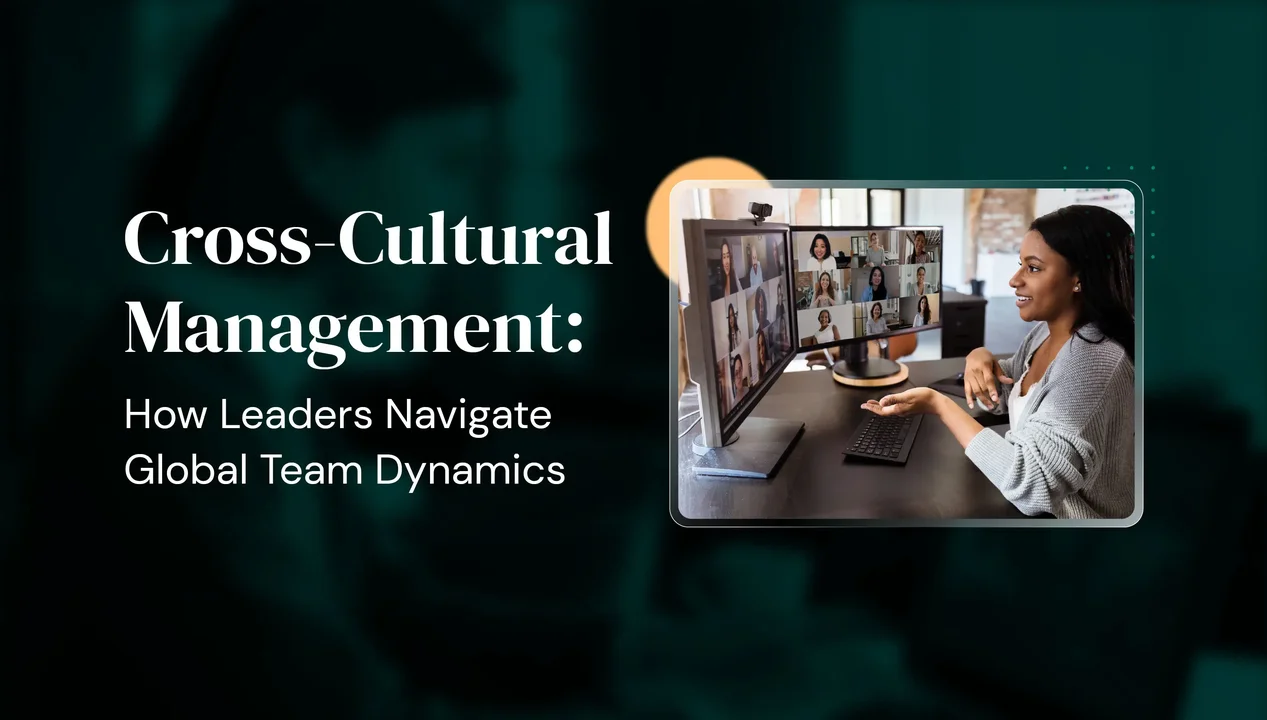
Cross-Cultural Management: How Leaders Navigate Global Team Dynamics
Not long ago, I joined a leadership call with a distributed team that spanned Mexico City, Berlin, and Manila. A small misunderstanding had stalled a critical rollout: the Berlin lead thought a teammate’s “yes” meant agreement, while the Manila team understood it as acknowledgment, not sign-off. No one was wrong, but the cultural assumptions underneath their communication were working against them.
Once we clarified what approval actually meant and put a simple written confirmation step in place, the project moved forward without friction. It was a reminder I see often in global teams: misalignment rarely comes from capability; it comes from invisible norms.
Today, with remote and hybrid work fully normalized, cross-cultural management isn’t a soft skill. It’s a core leadership competency tied directly to execution speed, team cohesion, and market reach. This article is written for founders, hiring managers, and operational leaders who need practical frameworks, not theory, to run multicultural teams that perform consistently and move quickly across borders.
Why Multicultural Teams Overperform (When They’re Led Well)
When global teams have the right conditions, they consistently outperform single-market teams. The research backs what many of us have experienced firsthand: multicultural groups bring broader perspectives, sharper problem-solving, and deeper market intuition. They stress-test ideas faster because they’re not all drawing from the same assumptions, and they can often spot risks earlier simply because lived experiences differ across regions.
But there’s an operational caveat leaders can’t ignore. The same diversity that fuels innovation can slow teams down when expectations aren’t explicit. I’ve seen teams with world-class talent miss deadlines because decision-making norms weren’t aligned or because “urgent” meant three very different things across time zones. Without clarity and trust, the advantages of global hiring don’t automatically translate into performance.
And as more companies hire nearshore and offshore talent, cross-cultural fluency is no longer optional. Leaders who manage distributed teams need the ability to interpret differences, establish shared rules of engagement, and create structures that prevent friction from undermining execution. It’s become a foundational leadership skill. One that directly shapes how quickly a global team can move and how reliably it can deliver.
The Core Frictions That Slow Global Teams Down
Even strong global teams hit predictable friction points when cultural norms aren’t made explicit. These patterns show up across industries and growth stages, and they almost always trace back to mismatched assumptions rather than capability gaps.
- Communication norms: Some teams default to direct, concise messaging. Others signal alignment more subtly. A “yes” might confirm understanding, not agreement, leading to commitments that were never actually made.
- Decision-making expectations: In hierarchical cultures, decisions move downward with clarity. In consensus-driven cultures, alignment is socialized first. When these collide, one side feels slowed down while the other feels bypassed.
- Time orientation: “Urgent,” “end of day,” and even “on time” mean different things across geographies. Without shared definitions, teams experience avoidable delays and misread each other’s intent.
- Feedback styles: Candid critique can feel abrasive to relationship-centered teams, while diplomatic feedback can be misread as vague or evasive. Both styles work until they operate without translation.
- Trust-building patterns: Some cultures build trust through delivery. Others through rapport. If leaders don’t design for both, teams interpret each other’s styles as disinterest or overstepping.
These frictions hit the core of execution. They lead to missed deadlines, blurred accountability, and teams working harder than necessary simply to stay aligned. Clear, intentional cross-cultural management turns these tensions into solvable operational challenges rather than recurring obstacles.
.webp)
How Effective Leaders Build Cross-Cultural Clarity
The leaders who run the smoothest global teams aren’t relying on encyclopedic cultural knowledge. They’re building environments where expectations are explicit, shared, and operationalized. Clarity becomes the equalizer that prevents misalignment from turning into execution drag.
Here are the practices I see consistently produce results:
- Codify communication rules of engagement: Shared norms for response times, when to escalate from async to sync, documentation expectations, and meeting etiquette remove the ambiguity that often fuels frustration.
- Use a shared language for decision rights: Frameworks like RAPID or RACI give distributed teams a common vocabulary for who decides, who contributes, and who executes, preventing decisions from stalling in the middle.
- Normalize written alignment: Leaders anchor teams in briefs, agendas, summaries, and decision logs. Written clarity replaces assumption-driven execution and supports teams working across time zones.
- Translate implicit expectations into explicit standards: In fast-moving startups, norms are often inherited rather than designed. Defining what “done” looks like, how updates are delivered, and how tradeoffs are made eliminates silent discrepancies.
The throughline is intentional design. If leaders don’t shape the operating system, teams default to their cultural instincts, and that’s where friction compounds. Explicit clarity keeps global teams moving in sync.
Adapting Leadership Styles Without Compromising Consistency
One of the hardest balancing acts for global leaders is knowing when to adapt and when to hold the line. Different regions respond to different leadership cues. Some teams move faster with direct guidance, others thrive when they’re coached toward solutions. The goal is to adjust your approach without diluting your expectations, not to reinvent yourself for every timezone.
I’ve watched this play out with a leader in my network who managed teams across APAC, LATAM, and the EU. With her APAC team, she leaned more heavily on structured check-ins and explicit task ownership because that rhythm created confidence and momentum. Her LATAM team moved best when conversations started with relational context before diving into deliverables. And with her EU team, she dialed up async documentation because they preferred autonomy and written clarity. The throughline: her standards never changed, only the pathway to get there shifted to match how each group worked best.
Seasoned leaders tend to flex across a few axes:
- Directive vs. coaching-based guidance: Adapting the level of structure without changing the bar for quality or accountability.
- Synchronous vs. asynchronous collaboration: Choosing the right mode for the task rather than defaulting to your home culture’s habits.
- High-context vs. low-context communication: Interpreting when brevity builds speed and when added context prevents misalignment.
Effective cross-cultural leadership is about being predictable in what you expect and flexible in how you support teams in getting there.
Operational Systems That Make Global Teams Run Smoothly
Cross-cultural competence helps leaders interpret differences, but it’s the operational systems underneath that determine whether a global team can move with consistency. When teams stretch across time zones and cultural norms, structure becomes the great equalizer, removing ambiguity, reducing emotional friction, and giving everyone the same playbook for execution.
The systems that reliably make the biggest impact include:
- Documentation as a cultural equalizer: Written briefs, decision logs, SOPs, and project outlines ensure no team relies on hallway context or verbal shorthand. Documentation levels the playing field for teammates who don’t share a native language or work-hour overlap.
- Project management standards that respect time zones: Clear ownership fields, structured handoffs, and asynchronous updates prevent work from bottlenecking in one region. Leaders who define what updates must be visible (and where) avoid the “lost in Slack” problem entirely.
- Meeting architecture designed for global participation: Setting rotating meeting times, distributing pre-reads, and capturing decisions in writing keeps teams included without forcing 2 a.m. calls or leaving critical discussions undocumented.
- Structured feedback cadences: Consistent rhythms, weekly one-on-ones, monthly performance check-ins, quarterly goal reviews, create predictability across cultures with different comfort levels around giving or receiving critique.
- Cultural briefings during onboarding: A short primer on communication norms, escalation expectations, and working styles across regions reduces early misinterpretation and accelerates trust-building.
These systems make teams reliable, not rigid. When the operational foundation is solid, cultural differences stop creating drag and start contributing meaningfully to how the team learns, solves problems, and executes.
.webp)
How Hiring for Cross-Cultural Competence Strengthens Global Execution
When companies expand their talent pools across borders, the question is who can do the job within a multicultural system. The leaders who hire well for global roles understand that technical competence alone won’t keep projects aligned or communication clean. Cross-cultural competence has become a core predictor of execution quality in distributed teams.
The traits I encourage leaders to screen for include:
- Awareness of high- and low-context communication: Candidates who can read nuance, ask clarifying questions, and adapt their messaging prevent the misunderstandings that slow global work down.
- Pattern recognition across cultural norms: Strong global performers spot recurring dynamics, how different teams escalate, how they interpret urgency, how they collaborate, without defaulting to stereotypes.
- Humility and curiosity: These candidates don’t assume their way is the default. They seek context and adjust quickly, which reduces friction in cross-functional work.
- Comfort with ambiguity: Distributed environments often lack the guardrails of in-office teams. People who can navigate imperfect information keep momentum from stalling.
The challenge is that these traits rarely show up clearly on resumes. They surface in lived experiences, behavioral patterns, and the alignment between how someone communicates and how a team actually operates. That’s why experienced global recruitment partners add real value: they know how to evaluate not just skills but cross-cultural fluency, and how to match communication styles with the environments where candidates will thrive.
Turning Global Talent Into a Competitive Advantage
Cross-cultural management is the mechanism that turns distributed talent into a faster, more resilient operating model. When leaders build clarity across cultural lines, friction drops, communication sharpens, and execution tightens. Teams start moving with a level of alignment that’s hard to replicate in single-market environments, and the diversity of perspectives becomes a genuine strategic advantage rather than a coordination challenge.
For companies hiring across borders, this isn’t theoretical. The quality of your cross-cultural leadership and your ability to hire people who thrive in multicultural environments directly shape your speed, cohesion, and long-term trajectory.
That’s where the right recruitment support becomes meaningful. Somewhere helps teams identify and onboard talent who not only meet the technical brief but also know how to operate smoothly within global systems. We’re here to help you find people who communicate clearly, adapt well, and strengthen alignment instead of adding management overhead.
If you’re building a distributed team and want the confidence that your next hires will elevate collaboration rather than complicate it, use the contact form below to get in touch.