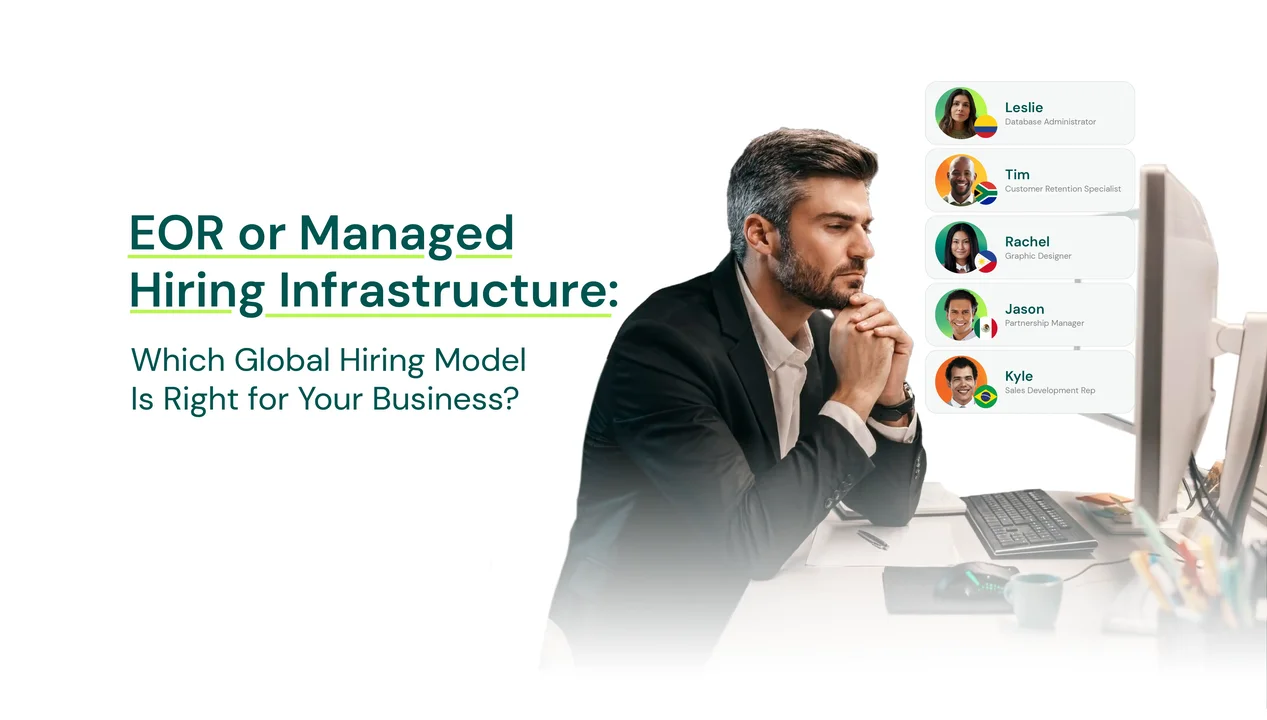
Global hiring is no longer reserved for large multinational corporations.
Today, venture-backed startups, mid-market companies, family-owned businesses, and enterprise organizations are all building international teams, accessing specialized talent, extending operational coverage across time zones, and scaling more efficiently than they ever could by hiring domestically alone.
For most business leaders we work with, the conversation has shifted. The question is no longer whether global talent should be part of the workforce strategy. The question is how that workforce should be built, managed, and supported, and which operational model makes that possible without overwhelming your internal teams.
As organizations expand beyond their domestic talent markets, new challenges emerge quickly. Employment laws vary by country. Payroll must be administered across multiple currencies. Tax obligations differ between jurisdictions. Benefits, worker classification, and compliance requirements become increasingly complex as hiring scales across borders. Without the right infrastructure, international hiring can place enormous strain on HR, finance, legal, and operations teams who are already running at capacity.
To address these challenges, two distinct hiring models are more widely adopted: the Employer of Record (EOR) model, and the Managed Services Hiring model, or more commonly referred to as Talent On-Demand.
Both approaches enable organizations to access international talent while significantly reducing administrative complexity. But each model is designed to solve a different business challenge.
We work with both frameworks every day, deploying each depending on a client's hiring objectives, internal capabilities, and growth stage. Neither is inherently better than the other. The right choice depends on how much of the hiring lifecycle your organization wants to manage internally, and how much support makes sense to bring in from an experienced partner.
Employer of Record (EOR): Hiring Global Talent Without Establishing Local Entities
One of the most common questions we hear from business leaders exploring offshore hiring for the first time is a practical one: how do you legally employ someone in a country where you have no registered entity?
The Employer of Record model exists to answer exactly that.
Under our EOR service, talent can be hired and employed in countries where your organization has no local legal presence. As your EOR service provider, we assume all legal employer responsibilities, including, contracts, payroll, compliance, benefits, tax obligations, while you retain complete control over the work itself. Day-to-day management, performance oversight, and strategic direction all remain with your team. The EOR simply provides the legal and administrative infrastructure that makes the employment relationship possible across borders.
The result is the ability to build international teams without the time, cost, and complexity of establishing foreign subsidiaries or registering local employment entities, a process that, in many countries, can take anywhere from three to twelve months and significant legal investment.
What Gets Managed Through the EOR Model
The full scope of legal, administrative, and compliance responsibilities associated with international employment is handled through the EOR framework. This typically includes:
- Generation of locally compliant employment contracts tailored to each jurisdiction
- Employee onboarding and employment administration
- Multi-country payroll processing and multi-currency salary payments
- Tax withholding and statutory reporting
- Benefits and insurance administration
- Leave and expense management
- Ongoing labor law compliance
- HR and employment support
What Stays Under Your Control
It's worth being clear about what the EOR model does not change. Operational ownership remains entirely with your organization. You define hiring requirements, participate in candidate selection, set performance expectations and objectives, manage day-to-day responsibilities and deliverables, oversee employee development, and maintain the culture and team engagement that make your business run.
From a practical standpoint, EOR employees function as fully integrated members of your team. The distinction lies primarily in how the employment is structured and administered behind the scenes.
When the EOR Model Is the Right Choice
The EOR solution tends to be the best fit when international hiring is a priority but establishing local entities in multiple countries isn't yet practical, or strategically necessary.
It's also worth clarifying a common misconception here: an EOR engagement doesn't require you to arrive with candidates already in hand. As your EOR partner, we actively support the sourcing and vetting process, sourcing, and hiring qualified candidates. The difference from Talent On-Demand is one of scope and structure, not of whether recruiting support is available.
This is the model we typically recommend when:
- You want recruiting support but prefer to retain close involvement in candidate selection and final hiring decisions
- You're exploring new geographic markets before committing to a permanent local presence
- You're sourcing specialized talent internationally that isn't available or affordable domestically
- You're building distributed teams across multiple countries simultaneously
- Hiring speed and compliance both need to work in parallel, not against each other
- You want to test offshore expansion before making larger structural investments
- Long-term, directly employed international team members are the goal
For organizations that want the right balance of recruiting support and internal hiring ownership, backed by a legally sound, administratively reliable employment infrastructure, the EOR model provides exactly that foundation.
.webp)
Talent On-Demand: A Fully Managed Approach to Global Hiring
The EOR model is a powerful solution, but for many of the clients who come to us, Internal HR teams are stretched or Recruiting pipelines for offshore roles don't yet exist or leaders are trying to scale faster than their current talent acquisition capacity allows.
In these situations, the problem isn't just employment compliance. It's everything that comes before it.
That's the challenge the Talent On-Demand model is purpose-built to address.
Under this approach, talent sourcing, candidate sourcing, screening, vetting, onboarding, workforce administration, payroll management, and ongoing support are all consolidated within a single engagement. Rather than coordinating independently between recruiters, payroll providers, compliance partners, onboarding processes, and workforce administrators, a centralized hiring framework manages the full lifecycle. You define the role, conduct final interviews, set business priorities, and manage the day-to-day work. We handle everything else.
For organizations with limited recruiting capacity, aggressive growth targets, or rapidly evolving workforce needs, this model removes the operational overhead that would otherwise slow everything down.
What Gets Managed Through a Talent On-Demand Model
Our Talent On-Demand Service covers a broader portion of the hiring lifecycle than a traditional EOR arrangement. Responsibilities typically include:
- Talent sourcing across international markets
- Candidate screening and skills assessments
- Interview coordination and shortlisting
- Contractor onboarding and engagement administration
- Payroll processing and multi-currency payments
- Compliance and documentation management
- Equipment procurement and deployment when required
- Ongoing workforce support and engagement monitoring
- Performance oversight and contractor replacement when needed
- Business continuity and succession planning
By combining talent acquisition and workforce administration into a single model, hiring timelines are reduced, vendor coordination is eliminated, and your internal teams can stay focused on the work that actually drives your business forward.
What Stays Under Your Control
You define role requirements, establish performance expectations and KPIs, and set the business objectives that drive your team forward. Performance oversight and workforce administration are handled on your behalf, so your leadership team stays focused on growth, not operational coordination.
When Talent On-Demand Is the Right Choice
A Talent On-Demand approach is most effective when speed, flexibility, and minimal operational overhead are genuine business requirements, not just preferences.
This is the model we typically recommend when:
- Internal recruiting resources are limited or already at capacity
- You're scaling teams quickly and need a faster path to hire
- You're building an offshore team for the first time
- Payroll and compliance administration aren't functions you want to develop internally
- Your workforce needs are likely to shift over the next twelve to eighteen months
- Long-term employment commitments aren't yet the right structure for your stage of growth
- You want a single point of accountability for the entire hiring lifecycle
For many growing organizations, the appeal is straightforward: access to talent, infrastructure, and workforce support through one operating model, with one experienced partner managing the complexity.
.webp)
Choosing the Right Model: A Practical Framework
The decision between EOR and Talent On-Demand ultimately comes down to one question: how much of the hiring lifecycle does your organization have the capacity, and appetite, to manage internally right now?
Organizations with established recruiting functions often gravitate toward EOR because they already know they need a legally compliant, administratively sound way to help them hire talent across borders.
Organizations scaling quickly, entering unfamiliar talent markets, or operating with lean internal teams often find that Talent On-Demand delivers something more valuable than compliance coverage alone, but a fully operational hiring infrastructure they don't have to build, staff, or maintain.
Both models work. Both are in active use by organizations at every stage of growth, across many industries. The businesses that get the most out of either model are the ones that chose it for the right reasons, based on an honest assessment of where they are operationally today, not where they aspire to be.
Building International Teams With Confidence
Global hiring is no longer a secondary consideration in workforce strategy. It is a structural lever for how companies scale.
EOR and Talent On-Demand are not competing approaches. They are different responses to different operational realities.
As global hiring continues to shift from an operational complexity to a genuine competitive advantage, having clarity on how these models work, and which one fits your business, matters more than ever.
For many growing organizations, the appeal lies in the ability to access talent, infrastructure, and workforce support through a single operating model.
Ultimately, the most effective global hiring decisions are not made by defaulting to a model, but by aligning structure with intent. The right approach depends on how your organization is growing, what internal capabilities already exist, and how much of the hiring lifecycle you want supported externally.
If you're working through that decision, we're happy to help you think it through, without assumptions, without pressure, and with the benefit of having done this across dozens of markets and hundreds of engagements.