What Is Cheaper Than Hiring US Employees in 2026? How Companies Build Global Teams
Quick Answer: What Is the Cheapest Alternative to Hiring US Employees in 2026?
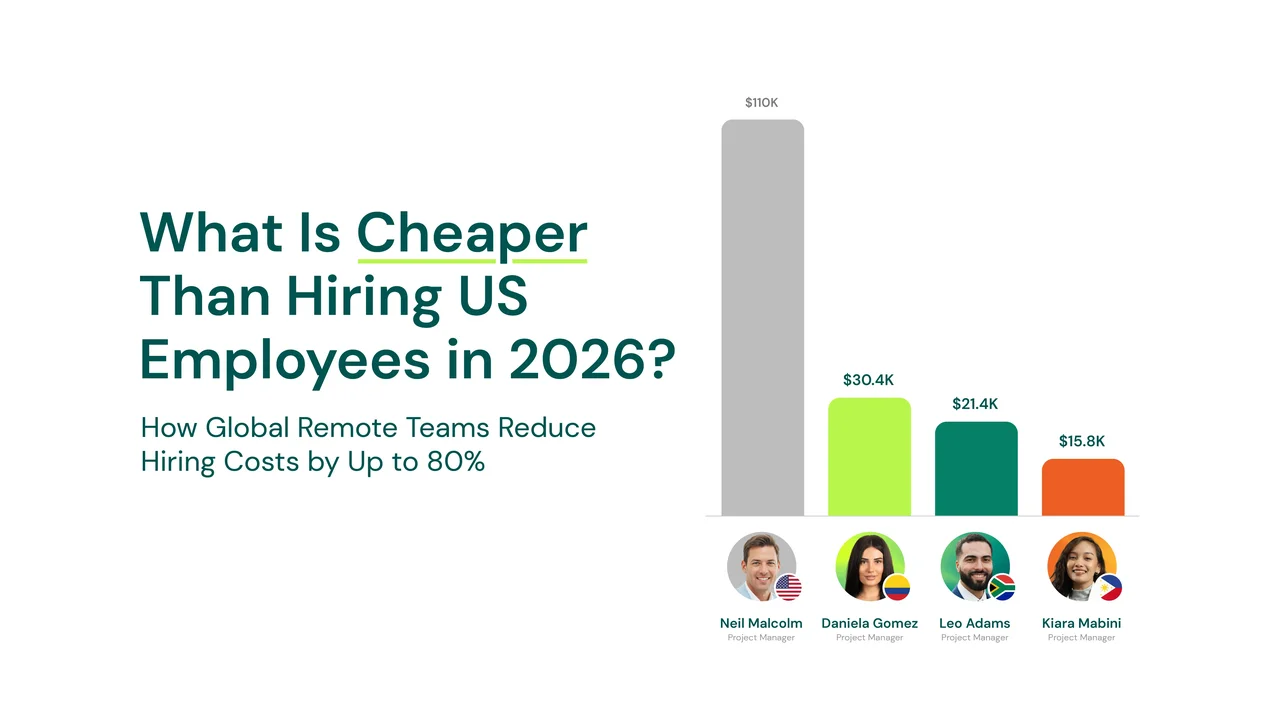
The most cost-effective alternative to hiring US employees in 2026 is offshore hiring, which allows companies to build global remote teams by accessing qualified professionals in established offshore talent markets. Instead of limiting hiring to expensive domestic labor markets, companies can access experienced remote professionals to build high-performing teams, improve workforce flexibility, and manage total employment costs more effectively.
The advantage of global hiring is not simply lower salaries. It is the ability to build a smarter workforce model by finding the right combination of skills, experience, and cost structure, regardless of location.
At Somewhere, we help companies source, vet, and hire remote professionals across global talent markets, such as Latin America, South Africa, and the Philippines. Our Salary Savings Calculator helps companies compare estimated compensation ranges by role and location, allowing them to evaluate where global hiring can create the greatest business impact.
Why US Companies Are Moving From Local Hiring to Global Talent Hiring
The way companies build teams is changing.
For decades, businesses competed for talent primarily within their local markets. In 2026, companies have a different opportunity: they can access qualified professionals across global talent markets.
Remote work has changed what is possible.
Companies can now build high-performing teams without requiring every employee to live in the same city, state, or country.
At Somewhere, we see businesses using global hiring strategies to:
- Reduce workforce costs
- Access larger talent pools
- Hire specialized skills faster
- Improve operational flexibility
- Scale teams more efficiently
The companies succeeding today are not limiting themselves to where talent lives. They are focusing on where they can find the best combination of skill, reliability, and value.
.webp)
Why Hiring US Employees Is More Expensive Than Companies Expect
Many companies underestimate the true cost of hiring a US employee.
According to the U.S. Bureau of Labor Statistics Employment Cost Index, employer compensation includes both wages and salaries as well as employee benefit costs. This means the true cost of hiring a US employee extends beyond the advertised salary and includes additional employer expenses associated with total compensation.
When businesses calculate hiring costs, they often focus only on annual salary.
However, the actual employer investment includes many additional expenses.
The Difference Between Salary Cost and Total Employment Cost
A salary represents only one part of employment cost.
A company hiring a US employee may also pay for:
- Employer payroll taxes
- Health insurance contributions
- Retirement benefits
- Paid vacation and leave
- Recruitment expenses
- Onboarding and training
- Equipment and software
- Management time
The total cost of employing someone is often significantly higher than the advertised salary.
At Somewhere, we encourage companies to evaluate hiring decisions based on total workforce cost rather than salary alone.
The key question is not:
"How much does this employee cost?"
The better question is:
"What is the most efficient way to access the skills my business needs?"
What Makes Offshore Hiring Cheaper Than US Hiring?
Hiring Offshore allows companies to access global talent markets where compensation structures differ while still hiring experienced professionals.
The cost advantage comes from expanding the talent pool.
It does not come from lowering standards.
Many offshore professionals already have experience working with:
- US-based companies
- Remote-first organizations
- International customers
- Digital collaboration platforms
- Distributed teams
At Somewhere, we help companies find professionals who understand remote work expectations and can integrate into existing teams.
How Much Can US Companies Save With Offshore Hiring in 2026?
Before comparing global hiring models, companies need to understand the full cost baseline of domestic employment. The BLS Employment Cost Index provides a useful benchmark because it measures employer labor costs by accounting for both wages and benefits.
The savings from hiring offshore depend on several factors. Companies should evaluate global hiring costs based on the total value a professional brings to the business, not simply by comparing salary numbers.
The cost of a remote professional varies based on:
- Role requirements
- Experience level
- Technical skills
- Location
- Industry
- Team structure
- Business requirements
A lower salary does not automatically create a better hiring outcome. The strongest global teams combine the right skills, experience, communication ability, and cost structure.
Compare Global Hiring Costs Using the Somewhere Salary Savings Calculator
Before making a hiring decision, companies need a realistic understanding of how compensation differs across roles and talent markets.
The Somewhere Salary Savings Calculator helps companies estimate compensation ranges for different roles and locations, allowing businesses to compare potential workforce costs and make more informed hiring decisions.
Companies can use the calculator to evaluate hiring opportunities across roles such as:
- Executive assistants
- Customer support professionals
- Finance specialists
- Marketing professionals
- Software Engineer
- Technical specialists
Salary estimates are designed to support workforce planning. Actual compensation depends on factors such as candidate experience, skill level, market conditions, and specific business requirements.
Which Roles Are Most Cost-Effective to Hire Offshore?
After helping companies build thousands of remote teams, we have identified several patterns and offshore hiring works best for roles that are:
- Remote-friendly
- Digital
- Process-driven
- Measurable through clear outcomes
Hire Offshore Executive Assistants and Administrative Professionals
Many companies use offshore executive assistants and administrative professionals to manage critical workflows and improve operational efficiency.
At Somewhere, we help companies hire experienced Executive Assistants who support:
- Calendar management
- Research
- Scheduling
- Documentation
- Travel coordination
- Internal operations
- Executive communication
A dedicated remote executive assistant allows business leaders to delegate operational tasks, protect their time, and focus on higher-value strategic priorities.
.webp)
Build Offshore Customer Support Teams
Customer support remains one of the most successful areas for global hiring.
We help companies hire Customer Support Representatives who manage:
- Customer inquiries
- Email support
- Live chat
- Phone support
- Ticket management
- Customer onboarding
Global customer support teams help companies increase service coverage, improve response times, and support customers across different time zones.
Hire Offshore Finance and Accounting Professionals
Finance operations often translate effectively into remote environments because many responsibilities follow structured processes.
Companies build offshore finance teams with professionals who support:
- Bookkeeping
- Financial reporting
- Reconciliation
- Accounts payable and receivable
- Financial data management
Somewhere helps companies hire finance specialists including accountants, financial analysts, bookkeepers, and other finance professionals through its global talent network.
Build Offshore Marketing Teams
Modern marketing teams increasingly rely on global specialists to improve output and execution speed.
Companies hire offshore marketing professionals for:
- SEO implementation
- Content production
- Campaign coordination
- Paid advertising
- Social media management
- Marketing operations
Somewhere helps companies source remote marketing professionals, including content writers, social media managers, paid advertising specialists, and other marketing roles.
Hire Offshore Software Developers and Technical Talent
Technical hiring remains one of the strongest use cases for global teams.
Somewhere helps companies access Software Engineers and technical professionals who support:
- Software development
- Quality assurance
- Data analysis
- Full-stack development
- Back-end development
- Technical operations
Global technical teams allow companies to access specialized skills while improving hiring flexibility and controlling workforce costs.
Why Offshore Hiring Is More Than a Cost Reduction Strategy
Lower employment costs are an important advantage of global hiring, but they are only part of the value.
Faster Access to Qualified Talent
Many companies struggle to fill roles in competitive US labor markets.
Global hiring allows businesses to access larger talent pools and reduce the delays caused by local hiring shortages.
Reduced Hiring Bottlenecks in Competitive US Markets
Instead of waiting months for the right local candidate, companies can evaluate qualified professionals across multiple regions.
This creates more options and improves hiring speed.
Access to Specialized Skills Without Increasing Fixed Costs
Companies do not always need one expensive generalist.
A global hiring model allows businesses to build teams with specialists across different functions.
Increased Operational Coverage Across Time Zones
Distributed teams can help companies improve:
- Time-zone coverage
- Response times
- Project execution
- Business continuity
How Companies Build Successful Offshore Teams
Finding lower-cost talent is only one part of offshore hiring.
The real challenge is finding the right people and creating the right team structure.
Define the Role and Expected Outcomes
Successful offshore teams start with clarity.
Companies should define:
- Responsibilities
- Performance expectations
- Communication processes
- Success metrics
Evaluate Candidates for Remote Success
Remote hiring requires more than technical ability.
Companies should evaluate:
- Communication skills
- Professional experience
- Remote work experience
- Problem-solving ability
- Cultural alignment
Create Strong Management Processes
High-performing global teams rely on:
- Clear communication
- Regular feedback
- Defined workflows
- Collaboration tools
Work With an Experienced Offshore Hiring Service
Many companies partner with specialists to reduce sourcing challenges and improve hiring outcomes.
At Somewhere, we help companies source, vet, and place remote professionals across global talent markets.
We handle the complexity of finding qualified candidates so companies can focus on building and managing successful teams.
How Companies Reduce Hiring Costs and Scale Faster With Offshore Teams
The best way to understand the impact of global hiring is to look at how companies have applied this strategy in real-world situations.
Across industries, companies are using offshore teams to reduce payroll costs, access specialized talent, and build flexible workforce models without sacrificing operational performance.
At Somewhere, we help companies identify, vet, and hire remote professionals who integrate into existing teams and support measurable business outcomes.
The following examples show how different companies hired talent through Somewhere to solve hiring challenges and build more efficient teams.
Real Examples of US Companies Reducing Hiring Costs With Somewhere
Companies looking for alternatives to expensive US hiring are increasingly turning to global staffing models to reduce payroll costs while continuing to grow. At Somewhere, we help businesses build dedicated offshore teams by connecting them with pre-vetted professionals across Latin America, South Africa, and the Philippines.
These client success stories show how companies have used offshore staffing to lower employment costs, expand their teams, and create more efficient workforce models.
SaaS Company Saves More Than $600K by Building a Global Operations Team
A growing SaaS company needed to increase operational capacity while managing the rising cost of US-based hiring. Instead of continuing to add expensive local employees, the company worked with Somewhere to build a global operations team.
By hiring qualified offshore professionals, the company reduced payroll expenses by more than $600,000 annually while expanding its ability to support business growth.
The company was able to:
- Access qualified professionals faster
- Increase operational capacity without significantly increasing payroll costs
- Build a larger team while maintaining financial flexibility
- Create a scalable workforce structure for long-term growth
Read the full SaaS case study to see how the company used global hiring to reduce costs and scale operations.
AI Technology Company Saves More Than $465K With Specialized Offshore Talent
An AI marketing technology company needed specialized talent to support growth while maintaining control over operating expenses. Rather than competing exclusively in expensive US hiring markets, the company partnered with Somewhere to build a global team.
Through offshore staffing, the company achieved more than $465,000 in payroll savings while gaining access to skilled professionals who supported critical business functions.
The company was able to:
- Hire specialized operational talent
- Increase business capacity without rapidly increasing fixed costs
- Improve hiring flexibility
- Build a stronger global workforce model
Read the full AI technology case study to learn how Somewhere helped the company create a more cost-efficient hiring strategy.
Construction and Engineering Company Saves More Than $645K Through Global Hiring
Offshore staffing is not only a solution for technology companies. A construction and engineering company worked with Somewhere to build a distributed team supporting engineering, operations, finance, and other business functions.
By accessing global talent, the company reduced hiring costs by more than $645,000 year one while expanding its operational capabilities.
The company was able to:
- Add skilled professionals without absorbing the full cost of US hiring
- Expand operational support across multiple functions
- Reduce hiring constraints in competitive local markets
- Build a more flexible and scalable workforce
Read the full Construction and Engineering case study to discover how the company used offshore staffing to support growth.
These examples highlight a key advantage of offshore staffing: companies are not simply replacing expensive US hires with lower-cost alternatives. They are building smarter workforce strategies that improve cost efficiency, increase capacity, and allow them to reinvest resources into growth.
What These Companies Have in Common
Although these companies operate in different industries, they followed a similar approach.
They focused on:
Hiring Based on Skills, Not Location
Instead of limiting their search to local markets, they expanded access to qualified professionals globally.
Building Teams Around Business Needs
They hired offshore talent based on the capabilities required to achieve business goals.
Creating Sustainable Workforce Models
They used offshore hiring to improve flexibility, manage costs, and support long-term growth.
The companies succeeding with offshore hiring are not simply looking for cheaper labor.
They are building smarter workforce strategies.
The Bigger Lesson: Global Hiring Is Becoming a Competitive Advantage
These examples show why more companies are changing the way they think about hiring.
The question is no longer:
"How much does talent cost in my local market?"
The better question is:
"Where can we find the right skills, experience, and value to help our company grow?"
In 2026, companies that combine local leadership with global talent access will have a significant advantage.
They will be able to scale faster, control costs more effectively, and build teams designed for the future of work.
Why Companies Choose Somewhere for Offshore Hiring
Building a global team requires more than access to candidates.
Companies need a hiring partner that understands:
- Talent quality
- Remote work expectations
- Role requirements
- Global hiring markets
At Somewhere, we help companies:
- Access Vetted Remote Talent Across Global Markets
- Reduce recruitment Time and Hiring Complexity
- Build dedicated offshore teams That Scale With Your Business
We work with companies looking to create reliable, scalable teams across multiple industries and functions.
The Future of Hiring: Why Global Teams Are Becoming a Competitive Advantage
The hiring landscape is moving beyond location-based employment models.
The old question was:
"How much does talent cost in my local market?"
The new question is:
"Where can I find the right skills, experience, and value for my business?"
In 2026, companies that build flexible global teams will have a competitive advantage.
They will access broader talent markets, adapt faster, and create workforce models designed for growth.
Frequently Asked Questions About Cheaper Alternatives to Hiring US Employees
What is Offshore Hiring?
Offshore hiring is the process of building a remote team by hiring qualified professionals who are located in another country. Instead of limiting recruitment to local talent markets, companies use offshore hiring to access a broader pool of skilled professionals while creating more flexible and efficient workforce structures.
Unlike traditional outsourcing, offshore hiring allows companies to build dedicated teams that work as an extension of their organization. Businesses maintain control over team priorities, workflows, communication, and performance while gaining access to global talent.
What Is the Difference Between Offshore Hiring and Outsourcing?
Offshore hiring allows companies to build dedicated remote teams that operate as an extension of their organization. Outsourcing typically involves hiring an external provider to deliver a service or manage a function.
Can Small Businesses Hire Offshore?
Yes, small businesses can hire offshore professionals to access skilled talent, improve operational flexibility, and build teams without being limited to local hiring markets.
Offshore hiring allows small businesses to fill roles such as administrative support, customer service, finance, marketing, sales, and technology without the same cost structure associated with hiring locally in high-cost markets.
The key to successful offshore hiring is having a clear role definition, strong communication processes, and a reliable hiring partner that can help identify qualified professionals who match the company’s needs.
Which countries offer the best offshore talent?
Popular offshore hiring markets include Latin America, South Africa, and the Philippines. The best location depends on skills required, time-zone preferences, and business needs.
What roles are easiest to hire offshore?
Common offshore roles include executive assistants, customer support representatives, finance professionals, marketing specialists, software developers, and technical professionals.
Does offshore hiring reduce quality?
Not when companies use strong hiring processes. Quality depends on candidate selection, role alignment, communication, and team management.
Bottom Line: Build a Smarter Workforce Strategy With Global Talent
The cheapest alternative to hiring US employees in 2026 is not simply finding lower salaries.
It is building a more efficient workforce model.
At Somewhere, we help companies access global talent, reduce hiring complexity, and build high-performing remote teams.
The future of hiring is not limited by geography.
It is defined by finding the right people, the right skills, and the right structure to help your business grow.